
The Game
How a raid works
This is how the game works today, written from its rules and its data. Every number on this page is read from the game's own files each time the site is built.
The raid
Twelve players in four teams of three drop into a dungeon generated for that raid. You queue alone or as a party, and the gear you wear decides which band of players you are matched with, so a fresh kit meets fresh kits.
A floor is stitched together from two or three biome regions, and the floors get harder the deeper you go. Past floor 100 the Descent ends and the Fathoms begin: every floor there carries a stack of Seals — named rules that change how it plays and what it pays — up to eight at once.
When the queue is thin, a raid is topped up with AI-controlled players. They are always marked [AI] on their nameplate.
The acts
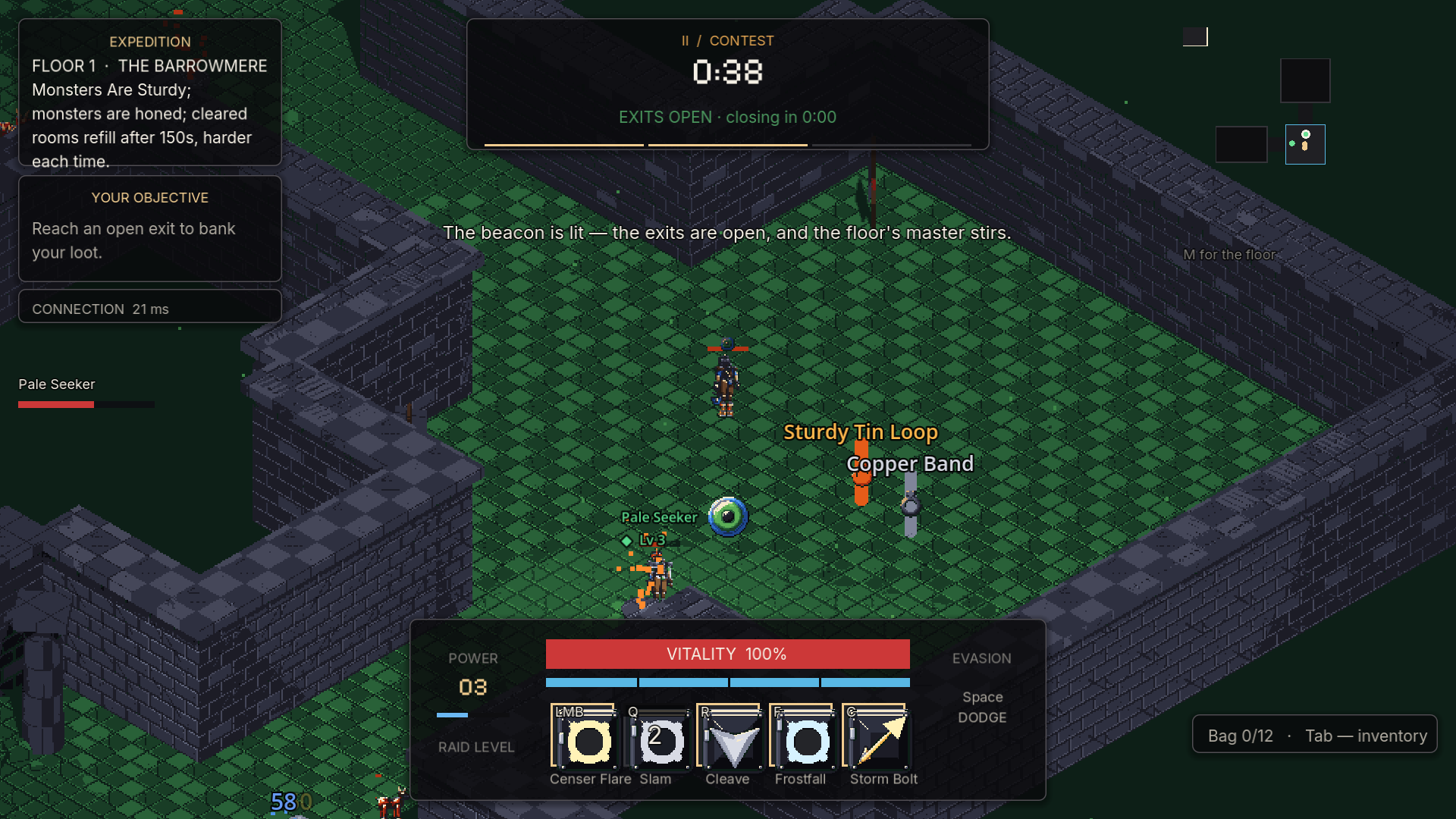
Every raid runs 20 minutes on one clock, and the clock decides when you may leave.
-
From the drop to minute 7
Descent
Exits stay sealed for the first 7 minutes. Nobody carries anything worth taking yet; the question is how much you can clear before the doors open.
-
Minutes 7–15
Contest
At minute 7 the boss beacon lights and extraction begins: two exits open for 30 seconds, then close for 90. Rooms you cleared fill up again over time — with fewer monsters, and meaner ones.
-
Minutes 15–20
Collapse
From minute 15 the dungeon collapses. Hazards strike two times as often, the fog thickens, and only one exit opens at a time, every 60 seconds, until the last one closes with the raid. Anyone still inside at minute 20 is lost, with everything they carry.
Getting out
- Extracting takes a 5-second channel at an open exit, and taking damage breaks it.
- Dying spills what you carried where you fell, for anyone to pick up.
- Downed is not dead. A teammate has up to 45 seconds to reach you and 5 seconds of holding still to bring you back.
- Pulling the cable is not an escape. A dropped connection leaves your body in the dungeon for 90 seconds: reconnect and you carry on, stay away and it can be killed like any other.
- After you fall, you watch your team through their own eyes — their health, their cooldowns, what they hear — until they are out or down.
Power inside the raid
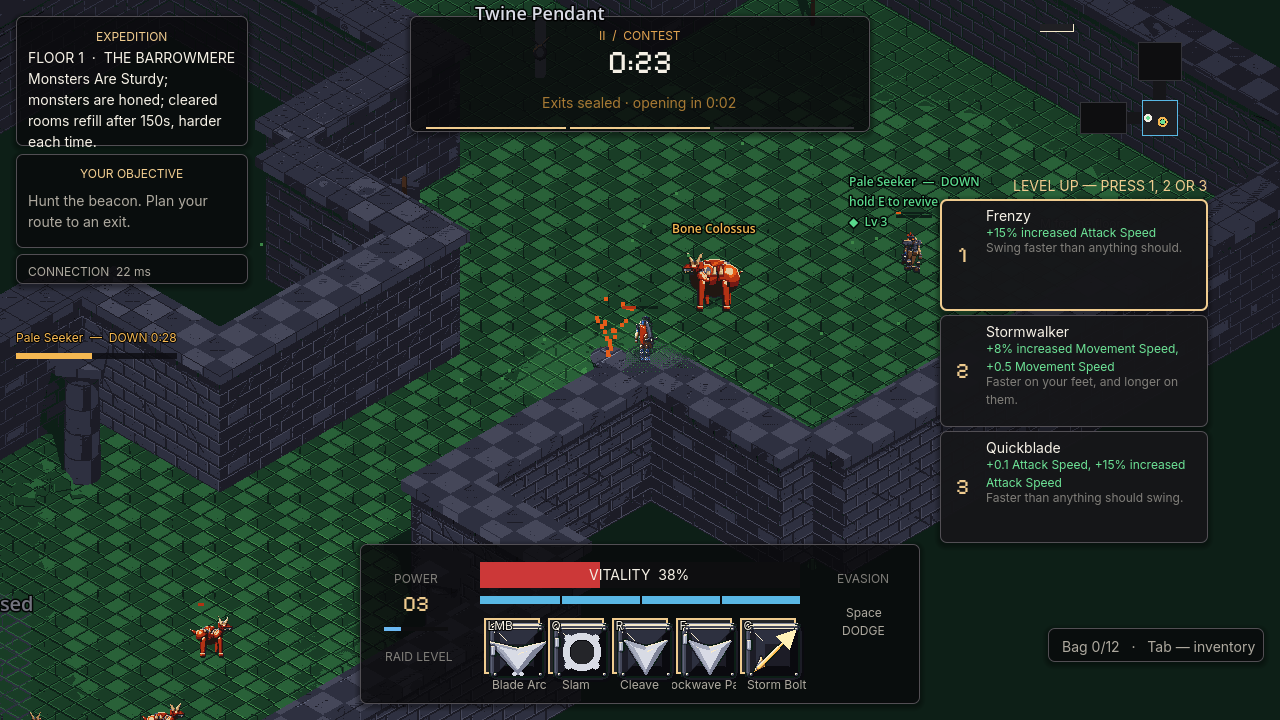
Monsters give experience, up to level 20. Each level offers three cards from a deck of 12, and you pick one while the fight goes on. Every pick is a small, fixed share of what your gear already does: the gear is the build, the cards make it bigger, and all of it resets when the raid ends.
Your abilities come from your gear. The weapon, artifact, amulet, gloves and boots you wear each fill one of five buttons: 13 items grant an ability, 27 abilities in all, counting the awakened ones. Change your gear and you change how you fight.
Loot
Rarity is an item's affix budget: a rarer item simply carries more modifiers. Items come in eight equipment slots, and every item states the power it adds and what it cost to exist.
Some items have sockets — up to three — for runes, which drop, bank and are insured like every other item.
- affixes
- 183
- item bases
- 84
- rarities
- 5
- item sets
- 8
- status effects
- 11
- runes
- 12
The star ladder
Duplicates are not junk. Fuse items of one tier into the next star, all the way to ★5. Each tier is built only from the tier below it, so a single item at the top stands on 720 base drops.
At the top, a weapon awakens: it trades its ability for a different, awakened one.
Insurance
Insurance is not something you buy or pick per raid: every item carries its own chance to come home after a death, shown on its card before you take it in. A common item with no stars comes back 50 % of the time; the chance falls with every rarity and every star, and it is zero for legendary items and for anything at the top of the ladder. It protects the ladder's currency, never its trophies.
Biomes and monsters
Four biomes, each with its own monsters, its own damage, its own hazard on its own clock, and its own pace for filling a cleared room back up.
-
The Emberworks
Fire, and a floor that erupts often. A room you clear does not stay clear for long.
- Damage
- Fire
- Hazard
- every 30 s
- Rooms refill
- after 120 s
-
Hollowfrost
Cold and heavy. Its hazards come least often, and a cleared room stays quiet longest.
- Damage
- Cold
- Hazard
- every 45 s
- Rooms refill
- after 240 s
-
The Stormvault
Lightning. The quickest hazards, the fastest refills, and rooms that fill up more times than anywhere else.
- Damage
- Lightning
- Hazard
- every 22 s
- Rooms refill
- after 90 s
Monsters
24 kinds of monster in seven families. A family is read by its silhouette and its colours, a room rolls its pack from a single family, and elites wear a crest and a mantle. Every floor has a master; these are the bosses:
- Dread Warden
- Hollow Sovereign
- Stormcrowned Maw
- The Gravebloom

Between raids
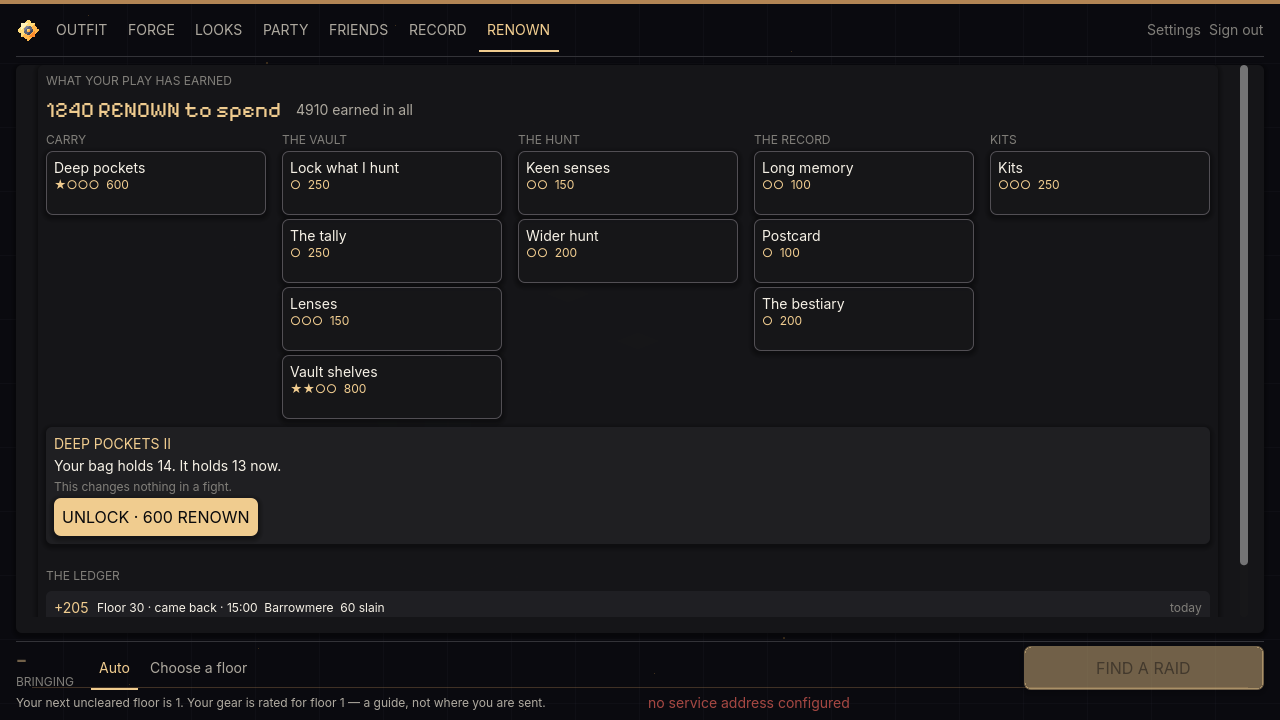
Your vault starts with room for 200 items and your bag for 12. Before a raid you choose what to risk; once matchmaking has placed you, your loadout is sealed until the raid begins.
Every finished raid earns Renown, extracted or not. It is spent on a catalogue of 24 conveniences — deeper pockets, more vault shelves, saved kits and lenses, a longer memory of your raids. It never buys strength: a veteran and a newcomer carrying the same items are exactly as strong.
The Hunt is a lens you write yourself, by slot, rarity, stars, set or affix. It filters your vault, and in a raid it lights up the drops that match and lets the rest recede.
With friends
Party up and queue together, and keep a friends list. After someone has been your friend for 24 hours, you can trade stashed gear in the menu: both lock the offer, both confirm exactly what they see, and nothing moves unless everything does.
There is no market, no price and no currency. Gear moves between friends, never between strangers.
Made by code
Sprites stand in a lit world of real geometry and are rendered at a low internal resolution with a curated palette of 48 colours, then scaled up in whole steps so every pixel stays sharp.
The music is synthesised as you play: hard dance at 142 to 150 beats per minute, a different style for each biome, climbing with the raid into the Collapse.
Fair play
A dedicated server decides every hit, every drop and every position; your client draws your own actions at once but never decides an outcome. There is no kernel driver, and there never will be.
Nothing that affects play is for sale. A cosmetic is a type that cannot carry a stat, and an automated test walks every one of them to prove it.
Closed alpha
Get an invite
The alpha opens in waves. Leave your e-mail address and I will send you a key when a place opens up. No newsletter: a confirmation, your invite, and a short note when the game reaches its next phase.
- Join the list
- Confirm your address
- Get your key and play